Jason Miller
Rachel Polet
Abe Olson
Ed Smit
Tom Speelman
Secrets of the Ancient Temple
Secrets of the Ancient Temple is a variation of Betrayal at House on the Hill, a game that is based on tile placement and random die rolls that determine which scenario will play out, and ultimately what the conditions to win are. Betrayal is a lot of fun to play with a large group, because the scenarios are very diverse and it's easy to have everyone work together, adding a nice coop element to the game. For Secrets, we came up with a few more unique scenarios that play off of a more competitive element. We have one dedicated to the idea that Medusa has appeared and is controlling all of the women characters, and the men have to fight their way out in order to survive. We have another one where Hades is trying to plunge the Temple into darkness, and torches must be lit to fight back. It was a lot of fun to come up with these scenarios, but also a lot of work because you want them to be fun but also balanced. You never want to hear players groan when a scenario starts because they feel like they have no chance.
Another aspect we incorporated into Secrets is we eliminated the upper and lower floors, leaving only the ground floor, but kept the number of rooms somewhat comparable. This makes the temple feel a lot larger and adds more strategy to playing. We also added trap rooms that trigger when you walk into them, such as a Dart room and a floor drop room. One of the most interesting things we added though was round events. At the end of every round, a card is flipped and an event occurs. For some rooms, we added some healing effects, whereas for others we made the traps activate. Some of my favorites are the Tongues of Flame effect, which shoots fire out of the door ways and makes it so that anyone in the Room of Eternal Flame or adjacent to it takes damage. Another one is the Ball Trap, which is similar to the classic trap in Indiana Jones with the rolling ball. If a player is in any of the rooms leading to it, they're hit and end at the end of the hallway. This really added a new level of strategy that we all enjoyed.
Secrets is a fresh take on Betrayal in a new setting, and it showed us how much fun coming up with your own scenarios can be. It really makes the game a lot more enjoyable, and it adds a layer of personal connection with it too!
Friday, January 31, 2014
Thursday, January 30, 2014
New Game: Warring States
Warring States is a conquest and resource-management based game set during the Warring States period in Chinese history. Players take turns moving military units, attacking neighboring territories, and building various structures in order to conquer all other players and become the new reigning dynasty.
The game is currently only balanced for play by 2 players. Each player will place territory markers on the board as noted in the setup document, followed by various buildings and 2 military units per owned city. The game then rotates through three phases per round: moving units, attacking territories (if possible), and constructing buildings (and paying upkeep) with the resources from the player's owned tiles. Below is the correct 2-player setup for the board.
The game currently only lasts a short amount of time, as 2-player games tend to do. It ends when one player has dominance over the map, either by preventing the other player from constructing further soldiers or by the other's surrender. We plan on balancing it for more players in the future. The board and pieces (aside from the few borrowed from Risk) are entirely custom-designed, a testament to the amount of work that we put into this project.
New Game: Arcane Summoners
Designer: Amy Wurzberger
In Arcane Summoners, a terrifying elemental beast has been summoned by a dark sorcerer. Each player is a mystical summoner with the goal of summoning their own elemental heroes and be the first to defeat this main boss. Each hero has a different elemental type and strength (as indicated by the number of spell cards they allow their summoner to draw) and some of the them have special abilities that either help their own summoner or sabotage the armies of fellow players. Depending on the elemental type of the boss (which is different each game) players will try to summon complimentary types of heroes in order to get bonus multipliers on their spell cards. The first player to attempt to defeat the boss and amass at least 100 points worth of spell cards wins.
Above is the game board. It shows which elements trump each other and it has movable markers so that players can keep track of the current elemental bonuses for that game. In this example the boss is a fire type, so water cards are worth double the points because water is stronger than fire and earth cards are worth half. On either side of that are summoning towers. This game utilizes an Uno deck, with the cards having new meanings. The color of the Uno cards correspond to different elements (ex: red cards are fire type). Any Uno card with just a number on it is a spell card. In order to summon a hero you need to place two spell cards of the same color on the corresponding tower (ex: a blue 7 and a blue 2 can be placed on the water spaces to summon a water hero the following turn). That means each tower has room for up to two people to summon at once.
Reverse cards let you change the elemental type of someone else's hero to the color type of the reverse card. Skips let you block two spaces on a tower so no one can use it to summon until after your next turn. Wild cards let you change one of your or someone else's heroes into any other elemental type. Draw cards just let you draw more cards immediately. Each turn a player draws 5 cards, plays as many as they are able and would like to play and discards anything they don't use. Any cards placed in towers come off the board at the beginning of their next turn and they receive their heroes from the hero decks.
When a hero is summoned the summoner takes the top hero card off the corresponding deck to the tower they used. Next to the hero's name is a number which represents how many spell cards of that color can be drawn when trying to defeat the final boss. For example if I had Hastur (pictured above) he is a yellow/air hero with a +4. That means that he allows me to draw and keep the first 4 yellow spell cards from the top of the deck. So if I drew a 4, an 8, a 2, and a 0 I would have a total of 14. And since the board tells me air cards are x1, my total is still 14. I need a score of 100 or higher to win the game. So ideally you try this when you've summoned lots of heroes, hopefully ones that are worth double.
Wednesday, January 29, 2014
New Game: Orbit
Designers: Gabriel Hoekstra & Jackson DeJong
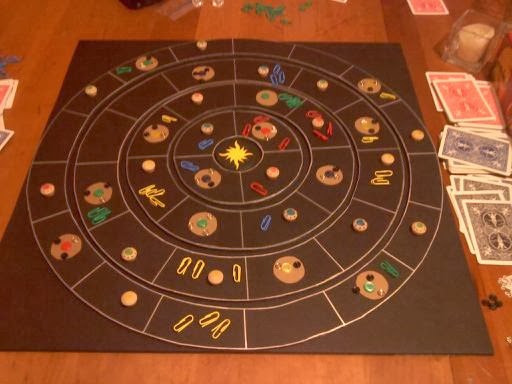
The year is 2234 AD. Humankind has extended an arm towards the stars in effort to colonize on a galactic level. Now, with four parties competing to control a new solar system, the race is on. Build colonies on new planets and equip them with solar fields, mineral refineries, and research laboratories. Build space stations and galactic battle ships to subject your opponents to the hell-fire that is your determination to win. In an ever-changing solar system of infinite improbability, toss logic to the wind and do the impossible!
Basic game play: players compete to earn victory points by building colonies on new planets, upgrading them to metropolises, building space stations, and battling opponents with battleships. Building resource operations on planets allows for the collection of solar energy, refined minerals, and data, all of which are required for the building of ships, colonies, and space stations. Each player begins with a fully operational metropolis, one space station, and one ship. The race then begins and battle ensue. Players earn one victory point per colony and two per metropolis (upgraded from a colony). Bonus victory points are given to players who achieve the following goals: building colonies on every planet in any given ring, building at least one colony in each of the four rings, and building all five space stations.
Variant of Settlers of Catan
Game Name: Disasters and Armies Expansion
Designers: Christian Wikkerink, Jason Arndt, Josh Ostrowski, and Grant VanderWall
Description: Disasters and Armies is an expansion that changes the way in which the game of settlers is played. The focus of the game is still the same however the expansion has changed the way that the strategies play. There are two variants of the expansion that allow for individual or team play. The focus of the game is to gain victory points in a similar manner as the original settlers. The difference in game play comes in the strategies used and the way you go about collecting your victory points.
Players: 2-4 with potential for more.
Objective:
- To individually or collectively with your partner reach the allotted amount of victory points. (10 or 17 respectively.
- To gain victory points through developing and expanding your settlements and the collection and management of resources.
So now you’re wondering what does this expansion even do?
The difference is found in the ‘robber’ or ‘thief’. We focused on the changing
of the importance on development cards and the use of the robber. In the
expansion the knight development card can move the robber not rolling a seven.
Now when a seven is rolled the player rolls the dice again to determine what
special rule will come into play. Depending on the roll of the dice the second
time there is a list of special rules that affect until another seven is rolled
or only take effect once. This changes the importance of development cards and
resource allocation. It also adds an additional factor of chance and how to
deal with it as best as possible. We added a catch-up mechanism into the
special rules so that it would allow for the losing team or player to make
his/or her way back into the game. The game can be played both individually
with a normal board set up or with teams in which the board looks like the
picture below.
Special Rules:
2. Nuclear blast- everyone looses a settlement or
city (City goes down to a settlement, Occurs once).
3. Starvation- Knight gets taken away from the
largest army (Occurs once)
4. Zombie sheep- If you have a sheep in your hand
you discard all other cards (Occurs once)
5. Obama
administration- First place gives to whoevers in last only one card
(continually happens until another seven is rolled)
6. Earthquake- The center of the person with the
longest road gets taken away (Occurs once)
7. Bountiful
Harvest- Collect a resource of any kind. (Occurs once)
8. Tsunami- All ports are unusable (Continually
occurs until another seven is rolled)
9. Sand Storm- All tiles touching the desert cannot
be used. (Continually occurs until another seven is rolled)
10. Inflation- everything increases by one. (2:1, 3:1
Ports, and 4:1 trading. Continually occurs until another seven is rolled)
11. Ore depletion- everyone discards all ore. (Occurs
once)
12. Forest fire- all wood gets discarded. (Occurs
once)
Game Variant: Rook & Hearts
Game Name: Rook of Hearts
Designer: Brendan Coallier
In my game there are two teams of two. The goal of the game is to not get any points. The team that gets to 300 points first loses. To start every hand the dealer deals out the entire deck and makes sure to have five cards in the kiddy. Next everyone looks at their hand and chooses three cards and gives them to the person to the left of them. This is a time when people can give their good (high) cards to their opponents. Next the person to the left of the dealer chooses trump. In this game they will most likely want to choose the color that they have the least of and make it trump this way they will not win many hands. In my game if a color is led then the people following the lead have to lay that color if they have it. Also the suit of trump trumps over every other color. The cards go in this order from high to low: 1,14,13,12,11,10,9,8,7,6,5,4,3,2,Rook.
In my game the scoring is the same as in Rook. 1's are worth 15 points, 14's and 10's are worth 10 points, 5's are worth 5 points, and the Rook card is worth 20 points. In playtesting my game I decided to take out the bidding aspect of the game. I found that it was too hard to bid and to not get set. However I did decide to keep the kiddy in the game for two reasons. One because then every person gets the same number of cards and also it gives a little bit of chance into the game. No one knows what is in the kiddy until the last hand is played. Which ever team wins the last hand they also win the kiddy. This can be bad because there might be points in the kiddy.
There is a comeback mechanism in my game. If a team wins all the points then they stay at whatever they were at and the competitors go up 180. Overall I believe that this game is a lot of fun and it worked out really well. I like how it takes hearts and adds teams to it this can be hard but makes it more fun because you do not know what your partner has in his or her hand. The game also takes the kiddy and keeps it apart of the game.
Ticket to Ride: Trading Edition
Variation of Ticket to Ride Original (US version)
Designer: Sam Ipema
This variation of Ticket to Ride is different in several ways. First, as shown in the title, a trading element was added to the game. This did not replace the players turn and could only be preformed on the individual's turn.
Another added element to the game is the option to remove another players train. In order to do this, a player must use his or her turn and have double the amount of cards required for a "normal" route. This action only removes and does not replace. It also can only be done if the route has not been completed by the individual who is having the train removed.
Bonus cards were also added as a catch up mechanism so that players could gain extra points by going through a city without having the points potentially count negatively against them. This action can be done while picking new destination cards. Any combination of bonus and destination cards can be used as long as the maximum picked up is 3.
The last edition is "Special Effects" cards that a player has the option of buying with a wild card. These are also different forms of catch up mechanisms incorporated. There are three options:
Double turn: player is allowed to do two actions in one turn
Die roll: the player rolls the die and the number that appears is the amount a player may select from another's hand.
Five points: these points count towards the end totally.
The board was not altered in any way so the picture is just of the cards/new rules.
Subscribe to:
Posts (Atom)


.jpg)